Saturday, April 19, 2025
Mentors
Saturday, April 12, 2025
Bubbled Up
Saturday, April 5, 2025
Mental Space
My day got away from me.
I’ve been dealing with some family things over the last few days and it’s taken up a lot of my mental space. (Nothing with Dan and the kids! For those of you that might worry).
But here are my numbers to date. I’ve fallen behind a little on my spear form but I intend to make those up here this week. I need to get a bit of sparring in as well.
Saturday, March 29, 2025
The Not So Ideal
I am currently in BC visiting family. I prepared myself for this mentally in terms of my training because I knew that it would be difficult to just drop and start doing setups in the middles of a family gathering. And unfortunately, privacy or alone time is limited. As is space. And so far it's been raining non-stop. And so my reps are happening in our bedroom. Any time I go in there, I make sure I do at least something. And my forms are done as repetitions in very small sections. Although not ideal, so far so good!
Saturday, March 22, 2025
Fatigue
1-on-1 AI Recap - March 22, 2025
*Reminder - AI recaps are not perfect or exact representations of the conversation
Quick recap
Malinda discussed her physical activities and training regimen, expressing concerns about overtraining and seeking advice from Jeff. They also discussed the book "Zen and the Art of Motorcycle Maintenance" and Malinda's personal demo for the grading year. Additionally, they explored different partners for throws and breakfall techniques, and worked on a complex sequence of movements for a martial arts form.
Next steps
• Malinda to continue practicing and refining her 5 applications, particularly focusing on throws with different partners.
• Malinda to work on her personal demo for the grading board, tailoring it to showcase skills that certain board members may not have seen.
• Malinda to practice the new spear form sequence, including the cyclone kick, spinning cyclone, and subsequent movements.
• Malinda to find a larger practice area without obstacles to properly execute the new spear form sequence.
• Malinda to complete reading "Zen and the Art of Motorcycle Maintenance" and prepare her assignment.
Summary
Managing Soreness in New Exercises
Malinda expressed her tiredness and soreness, attributing it to her increased physical activities and new exercises. Jeff advised her that while soreness is good for new activities, it could be a sign of overtraining if it persists. Malinda shared her experience of feeling more sore after a day of rest, indicating a potential need to reassess her training regimen.
Zen and the Art of Motorcycle Maintenance
Jeff and Malinda discussed the Zen and the Art of Motorcycle Maintenance book, with Malinda expressing confusion over the highlighted sections and notes in her copy. Jeff advised her to highlight important sections as she reads, rather than relying on someone else's markings. Malinda also sought guidance on her personal demo for the grading year, feeling uncertain about redoing forms and showing the same material. Jeff suggested that Malinda's demo should focus on her unique strengths and accomplishments, rather than just her Tai Chi skills. He also emphasized the importance of demonstrating her overall progress and achievements to the grading board.
Improving Breakfall Techniques With Female Partners
Malinda discussed her experiences with different partners, finding that throws felt better with Leon and Todai Raw compared to Laura. Jeff explained that this could be due to Owen's background in wrestling and his skill in grappling, which allows him to work with the thrower more effectively. Jeff also advised Malinda on proper breakfall techniques, emphasizing the importance of holding on to the partner during the throw to gauge the fall accurately. Jeff suggested that Malinda work with female partners, like Laura, to improve her breakfall skills.
Martial Arts Form Sequence Refinement
Jeff and Malinda discussed a complex sequence of movements for a martial arts form. Jeff guided Malinda through the steps, emphasizing the importance of proper technique and using the weapon to its full potential. They also discussed the need for Malinda to practice the sequence in a larger area without distractions. The next steps involve Malinda refining the sequence and incorporating it into the form.
Saturday, March 15, 2025
The Need For Good Leaders
The Tiny Tigers age ranges from about 5-7. So they're pretty young. Easily distracted and need help staying focused. And that's on a good day. Lol.
Even so, everything about the most recent Tiny Tigers class felt extra "high-strung" for lack of a better word. It wasn't that anyone was being "bad" per se. But it felt like the class was just abnormally "amp'd" up and I, as an Instructor, felt like I was on constant high alert.
I think I realized afterwards why this was.
Due to the roads, it was a small class. Only 6 kids. Which you'd think would have made things easier. But I realized later on that 5 of those 6 kids were actually our "more rambunctious" ones. We have a few kids in the Tiny Tigers that require a lot more hands on by the instructors. A lot more redirection. A lot more help paying attention and re-focussing. Great kids! Just a lot more high-maintenance, so to speak.
And they happened to be 5 of the 6 in that class, making the ratio of leaders to followers completely out of whack. I think I realized, from this class, just how important it is to have good leaders in a group...and to have enough good leaders to support the rest. The leaders not only set a good example but their energy also tends to keep the class grounded.
Without good leaders, without good examples for all of us, it can be easy to lose control and let chaos reign.
Sunday, March 9, 2025
1-on-1 Recap - March 9, 2025
*Remember - AI recaps are not perfect or exact representations of the conversation
Quick recap
Jeff and Malinda discussed various topics including Malinda's struggles with understanding certain concepts, the importance of open communication, and the challenges of navigating the politics within their martial arts school. They also discussed the evolution of martial arts styles, the need for a solid foundation for students, and the importance of understanding one's lineage. Additionally, they addressed a misunderstanding that occurred during a meeting, the challenges of navigating complex situations, and their experiences with recording and teaching martial arts techniques.
Next steps
• Malinda to continue practicing the spear jump technique, focusing on safety and finding the most comfortable landing position
• Malinda to show her 5 applications to Sifu Csillag for review
• Malinda to have Sifu Rybak review her 5 applications next week
• Malinda to obtain and submit electronic letters of reference for her pre-grading year
• Malinda to refine and present her spreadsheet to Jeff at a future meeting
Summary
Encouraging Open Communication in Teaching
Jeff and Malinda discuss Malinda feeling down during a previous meeting, which she attributes to feeling like she's "missing the mark" lately, particularly regarding her understanding of forms and foundational concepts. Jeff reassures Malinda that she should not censor herself when asking questions, emphasizing that open communication is crucial for effective student-instructor relationships and helps him understand how students process information. The conversation begins with some brief technical difficulties related to a Zoom update.
Understanding Intent and Application in Learning
Jeff and Malinda discussed the importance of understanding the intent behind a technique and the role of applications in learning. Jeff emphasized the need for students to figure out problems themselves and not just blindly accumulate knowledge. Malinda shared her struggles with understanding certain comments and the concept of "gimmicks" in their work. Jeff clarified that the goal is not to leave students to flounder but to help them progress.
Navigating Martial Arts School Politics
Jeff and Malinda discussed the challenges of navigating the politics within their martial arts school. Malinda expressed concerns about potentially causing issues and being seen as a troublemaker. Jeff emphasized the importance of transparency and honesty, even if it leads to some conflict. He praised Malinda for her role in opening up discussions about certain issues, such as the helmet crusher incident, which allowed for a more informed and contextual approach to addressing these problems.
Clarifying Martial Arts Intent and Application
Jeff discussed the importance of understanding the context and intent behind teaching martial arts techniques. He emphasized the need for students to learn from different instructors to gain a comprehensive understanding. Malinda shared her struggles with defining the original intent and application of martial arts forms, questioning the terminology and its implications. She proposed the idea of external and internal applications, and the need for clarity on intent to application. The conversation ended with Malinda acknowledging the complexity of the topic and the need for further exploration.
Adapting Martial Arts Styles for Survival
Jeff discussed the evolution of martial arts styles over time, emphasizing how each style must adapt to survive and appeal to a diverse range of practitioners. He used historical examples to illustrate this point, such as the development of Kempo and the changes in Kung Fu forms over time. Jeff also used the metaphor of the Borg from Star Trek to convey the idea of merging with a style rather than allowing it to change you.
Evolution of Martial Arts Styles
Jeff and Malinda discussed the evolution of martial arts styles, particularly Hung Gar and Lao Gar, and how they have been influenced by various lineages and practitioners over time. They emphasized the importance of understanding one's lineage and the physical characteristics of its practitioners to fully comprehend the style. Malinda expressed her desire to create her own form and the excitement of seeing what others might come up with. Jeff also highlighted the need for a solid foundation for students and the limitations of their own thoughts and experiences in understanding their lineage.
Navigating Complex Relationships With Trust
Jeff and Malinda discussed the challenges of navigating complex situations and maintaining trust in their relationship. Jeff expressed concern about exposing Malinda to potentially damaging situations, but also acknowledged her ability to handle them. They agreed on the importance of open communication and addressing issues as they arise. Malinda committed to bringing up any concerns or disagreements in real-time, and Jeff appreciated her commitment to their relationship. They also discussed the need for emotional intelligence and the importance of considering their long-term relationship when making decisions.
Jeff and Malinda Discuss Move Modification
Jeff and Malinda discussed Malinda's struggles with a specific move in her performance, which involves jumping and landing on her left leg. Jeff suggested that Malinda's left leg might be causing her knee to torque, and recommended that she try landing on her right leg instead. Malinda expressed her desire to stay true to the original move, but also acknowledged the potential risks involved. Jeff advised Malinda to modify her move to a stand-up, turn around, and thrust, as the original move might be too risky. They also discussed the differences in how right-handed people shoot in hockey and baseball, with Jeff explaining that most right-handed people shoot left in hockey.
Martial Arts Techniques and Applications
Jeff and Malinda discussed their experiences with recording and teaching martial arts techniques. Jeff shared that he had not recorded his own techniques, but had taught the spirit form to Sifu Plater. Malinda is working on her 5 applications and sought Jeff's insight on the monkey crawl technique, which Jeff explained involves an interception, transfer, and counter. Malinda plans to show her applications to Sifu Rybak and Sifu Csillag for feedback. They also discussed the need for letters of reference for her pre-grade year.
Saturday, March 8, 2025
A Good Day
Friday, March 7, 2025
This Might Be One To Just Scroll By
Disclaimer: I recognize that as I worked through this blog, it started one way, changed to another, shifted back, then did a 360, and then landed in space where it currently floats without any gravitational pull. But perhaps this is important for me to recognize that I just might be in a state of flux or maybe even a void. I don't see this as good or bad just yet...simply what it is. But as I publish this I really don't know where I was going with any of it so take it all with a grain of salt. Although I started last nights meeting with a thumbs up, I must admit I left feeling like some things discussed weren't sitting well with me. I haven't figured out why just yet. And so my headspace is also a little clogged.
Saturday, March 1, 2025
A Good Start
Tuesday, February 25, 2025
A 3 Step Approach
Teaching children can be tricky and is much different than teaching adults. Adults will more often have a longer attention span and can handle a bit more theory within the lesson. Adults have typically made the choice to be there and to learn, where as kids, on the other hand, are really only interested in having fun. So we either need to find a way to make the content fun or we hide the content inside the fun.
I have found some fairly consistent success with a certain approach that I’ve been utilizing for a while and I thought it might be worth sharing. This is definitely not the only approach, but hopefully it’s one you might be able to add to your repertoire. As I go through these steps, I will also share the example of a recent lesson where we worked on the roundhouse kick.
Part 1 - The Knowledge. Fun.
Part 2 - The Focus. Funner.
Part 3 - The Application. Funnest.
The Knowledge
This portion should come first and needs to be kept short. It can be used as a refresher for the older students, and/or as a brief introduction for the newer ones. You really only have their attention for maybe about 3-4 minutes here, max. Although this would be considered the “theory” portion of the lesson, it cannot just be talking, and needs to be balanced with doing. In fact, the doing should lead the lesson, not the talking. They also still need an opportunity within here to move and have some fun as well.
Roundhouse Example. We stayed set up as a full class with an instructor at the front. The Instructor immediately had them go into a bow stance (they did NOT start with talking) and had them do a few roundhouse reps. Then, while still in a bow stance, they started to refresh the class on the components of the roundhouse and took them through a few more reps in a “step-by-step” format, challenging their balance and having some laughs with it. They finished with the last few at full speed once again. This portion was kept short but active.
The Focus
This portion is a specific aspect that you want to work on and would also likely be the bulk of the lesson. So within the overall lesson, what will your main objective be for this particular class? Ideally, this is an activity where the student isn’t repeatedly TOLD what they should be working on, but rather is a fun game or challenge by which they will have no option BUT to work on said skill.
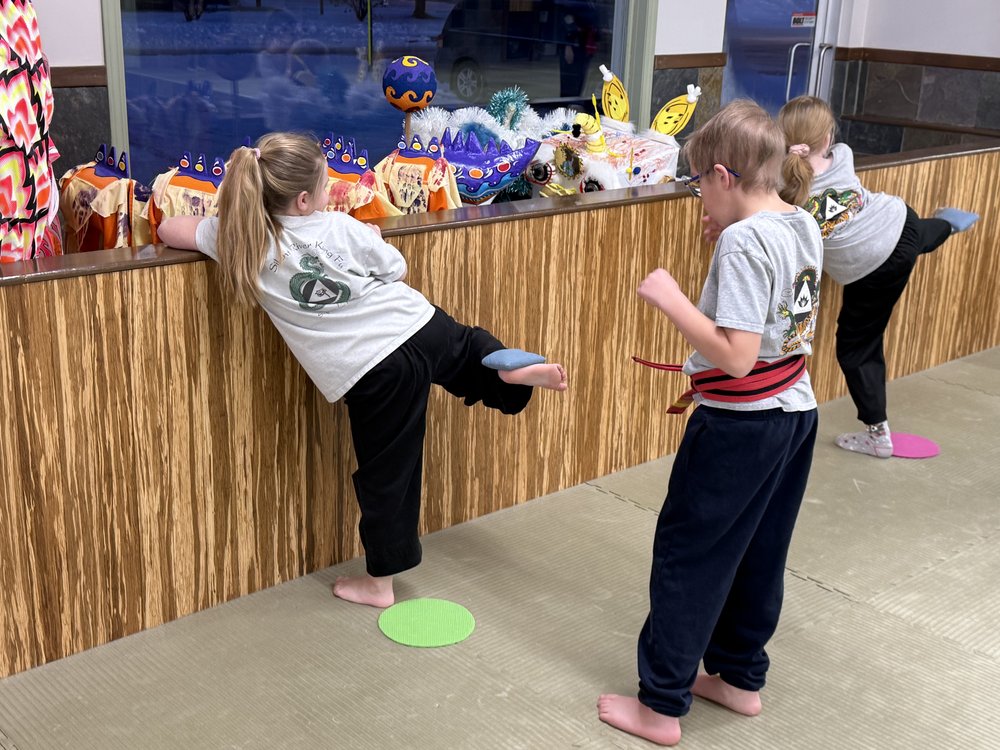
Roundhouse Example. We partnered the students up and had them find a dot along the ponywall. The first partner held the wall for stability while doing a roundhouse kick, up to and including the 3-point. While holding that 3-point, their partner then placed a bean bag on their ankle, from which point they were challenged to complete the kick (slowly) as many times as they could without dropping the bean bag. As far as the students were concerned, this was a “don’t drop the bean bag game”, which for them was a fun challenge. But in actual fact, they were working on their proper 3-point, their body alignment and hip strength.

The Application
This portion comes last and should be the most fun. We want to end the overall lesson on a really high note. This is also the students opportunity to apply what they were just working on and for the instructors to see how much of it potentially sunk in. I think of this section as “organized chaos” and should be fast paced with smiles and pink cheeks by the end. At this point in the lesson, I would be looking less to correct any of the students, and more just taking mental notes of what needs work the next time.
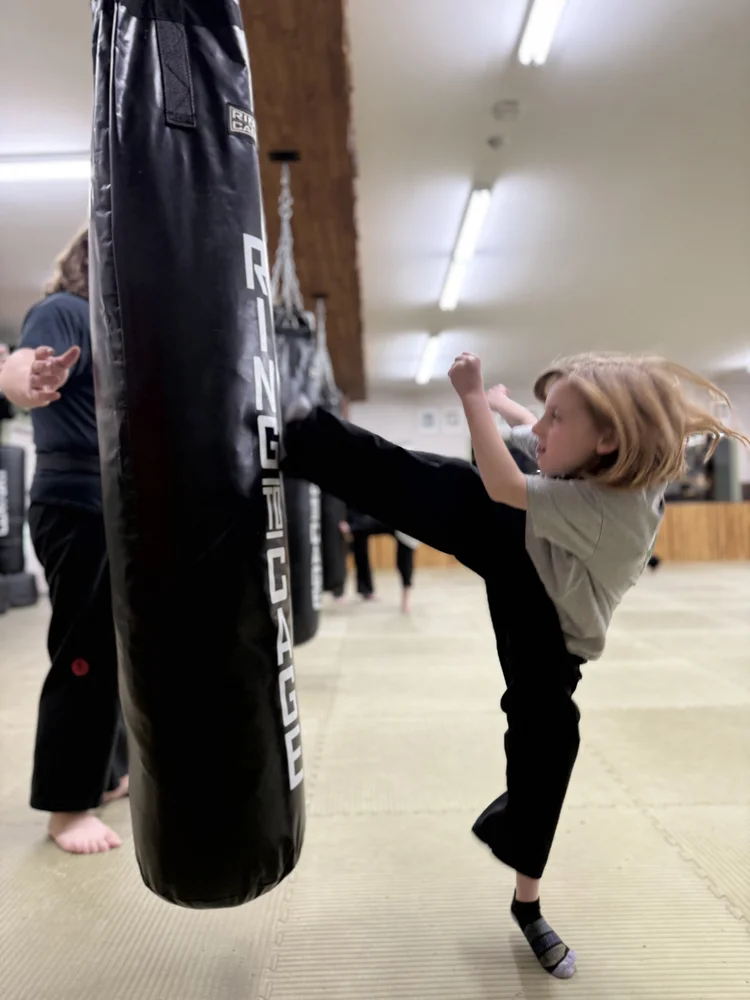
Roundhouse Example. We separated the students into groups lined up towards the heavy bags. They were challenged to run to the bag and then had to do 1 or more roundhouses at the direction of the instructor at that bag. The first round may have been a low roundhouse. The second, high then low. Third, high, low, high. And so on. The final round they got to do their best flying roundhouse.

By the end of this particular class, I was really impressed by how their technique was looking in the Application portion. Everyone was pivoting and getting that proper body alignment that they had gotten used to along the wall, and many were implementing really good 3-points as well, especially when challenged with those different height kicks. And they were having a blast at the same time.
What truly made me realize that this approach had some benefits, was when Sihing N Csillag planned their next class on the side heel in the same format. It was essentially the same general setup, with different content, and the students didn’t even notice. At the same time, they were able to reiterate some of the similar skills between the roundhouse and the side heel (ie. the pivot and body positioning) and by the end of the second class we were seeing some really amazing progress. Sidenote: This is now making me take a good look at what lessons might work really well back to back.
When we discover a successful drill, our instinct tells us we need to replicate it exactly so that we get the same result. But what tends to happen is we will use it over and over to the point that it becomes old and boring, no longer having the same effect. Instead of copying the drill itself, I’m trying to figure out what made that drill successful and then replicate the approach. I think if we can figure out how to do that, the potential for successful drills, and successful classes, become endless.
Saturday, February 22, 2025
1-on1 Recap - February 22, 2025
*Remember - AI recaps are not perfect or exact representations of the conversation
Quick recap
Jeff and Malinda discussed various martial arts techniques, including the use of monkey fists and mantis claws, as well as proper spear technique. They also shared personal experiences and discussed the challenges faced by instructors and students in balancing their responsibilities. The conversation concluded with a discussion on instructor development challenges and effective teaching approaches, with Malinda sharing a successful three-component teaching method she used for kicks.
Next steps
• Malinda to write an article about the three-component teaching approach (theory, focused activity, free practice) and post it on the instructor site group
• Malinda to follow up with instructors who want more involvement by having them propose specific plans and ideas rather than creating additional work
• Malinda to continue developing Young Dragons program independently before involving additional instructors
Summary
Martial Arts Techniques and Spear Handling
Jeff and Malinda discuss technical aspects of martial arts movements. Jeff clarifies that a monkey fist is used for striking (particularly with the wrist against soft tissue) while a mantis claw is for blocking, though the hand position is the same. They also review proper spear technique, with Jeff demonstrating that one should lift and grab from below rather than above, moving toward the end of the spear during the cross step to maximize range. The conversation ends with Malinda preparing to share a story about herself and her dog.
Intuition and Humility in Decision Making
Malinda shared a personal experience where she felt a strong connection to her dog, Avery, who was left outside all night. She had been feeling cold and unwell, which she now believes was a sign that something was wrong with Avery. Malinda acknowledged that she had not been listening to her intuition and had not checked on Avery as she should have. Jeff discussed the importance of maintaining humility and not assuming one knows everything, while also trusting one's intuition. He shared his own strategy of not allowing doubts to enter and always checking his surroundings when he feels a change in his energy field.
Managing Instructor Expectations and Workload
Malinda discussed her challenges with instructors, who she appreciates but struggles to manage their expectations and workload. Jeff suggested that Malinda should ask the instructors if they are seeking more involvement due to a lack of work or to support her in managing the class.
Instructor Development and Teaching Approaches
Jeff and Malinda discuss instructor development challenges and effective teaching approaches. Jeff emphasizes that instructors should focus on student needs rather than just following instructions, and explains how reducing advancement requirements to forms helps both students and instructors teach more mindfully. Malinda shares a successful three-component teaching method she used for kicks, which consists of brief theory, focused fun activities, and free practice, leading to remarkable student improvement. Jeff suggests Malinda write an article about this approach to help other instructors understand the importance of being creative rather than just repeating specific drills.